
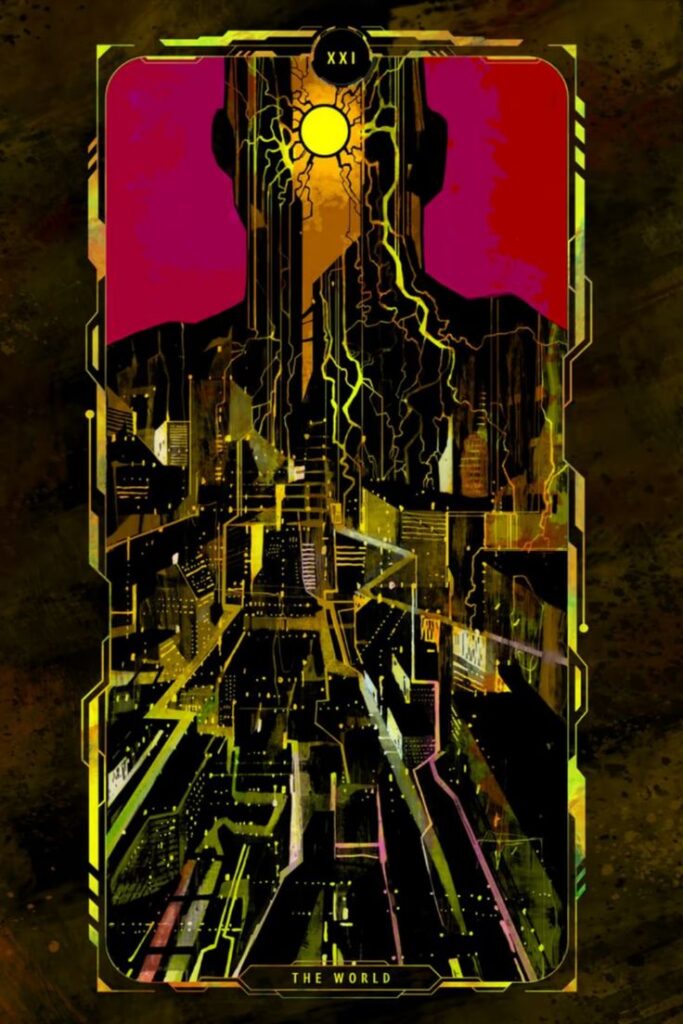
Cyberpunk 2077 è un videogioco open world che permette un’esperienza immersiva all’interno di un mondo cyberpunk. La città che ospita questo mondo, Night City, è liberamente ispirata ai romanzi di William Gibson. Tra le varie esperienze caratteristiche che si possono fare, facoltativamente alla trama principale, si possono raccogliere e leggere delle poetry shards. Innanzitutto l’intero ambiente distopico è segnato da una costante ricerca spirituale dato che il protagonista, V, fronteggia una profonda crisi d’identità. La riflessione sulla morte diventa una parte centrale della trama e questa viene stimolata da diversi elementi del gioco. Per esempio, gli eventi cruciali del protagonista, così come i luoghi più importanti, saranno segnati dalla presenza di murales che riprendono gli archetipi dei tarocchi, proprio per ispirare la riflessione.
Le poetry shards offrono contenuti molto diversi tra loro, ma si inseriscono in questo percorso esistenziale e lo riflettono. Alcune poesie offrono immagini di morte come Perché così tante candele…, Morte di un mercenario, Ballata di Due Sorelle, oppure ci accompagnano su un percorso liminare verso un nuovo stato come in Chrome and You, Estrambe le Estremità della Scala e Umile Debutto.
Altre poesie invece riflettono sulla nascita di un nuovo mondo audace ed ardente che osa andare oltre senza conoscere limite. Questo possiamo osservarlo negli estratti di William Blake da America: A Prophecy e da Il Matrimonio del Cielo e dell’Inferno, o come nella poesia La Caduta di Etemenaki
Non è possibile riflettere generalizzando sulla forma delle poesie perché in realtà vengono da situazioni completamente diverse. Di alcune poesie non si conosce nemmeno l’autore, altre poesie invece sono scritte da autori famosi del passato come William Blake, Bolesław Leśmian, Konstanty Ildefons Gałczyński e Oswald Durand. Credo che il lato affascinante delle poetry shards all’interno del gioco consista proprio in questo, che esse vengono trovate casualmente durante il gameplay come potremmo incappare noi in una poesia durante le nostre giornate. Il fatto poi che le poesie sembrano parlare proprio al protagonista rende tutta l’esperienza più prodigiosa.
| AMERICA: A PROPHECY The Terror answerd: I am Orc, wreath’d round the accursed tree: The times are ended; shadows pass, the morning gins to break; the fiery joy, that Urizen perverted to ten commands, What night he led the starry hosts thro’ the wide wilderness, That stony law I stamp to dust; and scatter religion abroad To the four winds as a torn book, and none shall gather the leaves; But they shall rot on desert sands, and consume in bottomless deeps, To make the deserts blossom, and the deeps shrink to their fountains, And to renew the fiery joy, and burst the stony roof; That pale religious lechery, seeking Virginity, May find it in a harlot, and in coarse-clad honesty The undefil’d, tho’ ravish’d in her cradle night and morn; For everything that lives is holy, life delights in life; Because the soul of sweet delight can never be defil’d. Fires enwrap the earthly globe, yet Man is not consum’d; Amidst the lustful fires he walks; his feet become like brass, His knees and thighs like silver, and his breast and head like gold. It is an extract from William Blake’s prophetic book America a Prophecy. | AMERICA: UNA PROFEZIA Il Terrore rispose: Io sono un Orco, avvolto intorno all’albero maledetto:I tempi sono finiti; le ombre passano, il mattino comincia a sorgere;la gioia ardente, che Urizen pervertì in dieci comandamenti,quella notte in cui guidò le schiere stellate attraverso l’ampia landa desolata,quella legge di pietra io calpesto in polvere; e disperdo la religioneai quattro venti come un libro strappato, e nessuno ne raccoglierà le foglie;ma marciranno sulle sabbie del deserto e si consumeranno in profondità senza fondo,per far fiorire i deserti e rimpicciolire gli abissi alle loro sorgenti,e per rinnovare la gioia ardente e far scoppiare il tetto di pietra;quella pallida lussuria religiosa, in cerca di verginità,potrà trovarla in una prostituta e in un’onestà rozzamente vestital’incontaminata, sebbene rapita nella sua culla notte e mattina;Poiché tutto ciò che vive è sacro, la vita si diletta nella vita;Perché l’anima del dolce piacere non può mai essere contaminata.I fuochi avvolgono il globo terrestre, eppure l’uomo non ne è consumato;cammina tra i fuochi lussuriosi; i suoi piedi diventano come ottone,le sue ginocchia e le sue cosce come argento, e il suo petto e la sua testa come oro. È un estratto dal libro profetico di William Blake, “America una Profezia”. |
| BOLESŁAW LEŚMIAN, “WHY SO MANY CANDLES…” Why so many candles, these faces above me? No more harm shall ever meet my body. Everyone is standing – while here alone I lie – Grieving, feigning. One must be true when one must die. And so, buried under these wreathes of leaves, I lie – Solemnly – Agelessly – Solitarily. Death, gone silent, once again rushes to my head, Though by now I know all comprehension is dead. How I loathe to become accustomed to this grave, To be what I once was – that is all I crave. It is a poem from the important Polish poet Bolesław Leśmian. Translated from Polish by Stefano Salsicciao | BOLESŁAW LEŚMIAN, “PERCHÉ COSI’ TANTE CANDELE…” Perché così tante candele, questi volti sopra di me?Nessun male colpirà più il mio corpo. Tutti sono in piedi – mentre qui giaccio solo -Afflitto, fingendo. Bisogna essere sinceri quando si deve morire. E così, sepolto sotto queste ghirlande di foglie, io giaccio -Solennemente – Senza età – Solitario. La morte, divenuta silenziosa, mi assale di nuovo alla testa,Sebbene ormai sappia che ogni comprensione è morta. Quanto detesto abituarmi a questa tomba,Essere ciò che ero una volta – questo è tutto ciò che desidero. È una poesia dell’importante poeta polacco Bolesław Leśmian. Tradotta dal polacco da Stefano Salsicciao |
| DEATH OF A MERCENARY, AUTHOR UNKNOWN Quick enough – not I Nor bold enough nor agile Tangled up in wires Like a nest of vipers vile Was it I who fell? Or was it done to me? Dissolving, disappearing, with you I wished to be Now tethered, clamoring, the restless swarm Beating in my ears a pale rage – No! Into the earth I seep, my life the sweet Thorn sticks in my throat A chill burns brighter – On To the end? What a thought A huddled husk I tumble for the dawn – The old certainty of youth is felled And from its gnarled trunk Memories fall forth Hours of ours sharp and pressing race Embittered in a powerlocked embrace With you I wished to be and so I go! Down a road without end through woods half-dreamt And the chill-bleached delirium of desire Flies into trepid trembling sand Through the fog of your shadow sharpening The storm tangles in me once again To sway with you like sweet grasses dry Still the glassy dust will naught but rise | MORTE DI UN MERCENARIO, AUTORE SCONOSCIUTO Abbastanza veloce – non sono statoNé abbastanza audace né agileAvvolto nei filiCome in un nido di vili vipere Sono stato io a cadere? O mi hanno incastrato?Dissolvendomi, scomparendo, desideravo stare con te Ora legato, strepitando, lo sciame inquietoRimbombando nelle mie orecchie in una pallida rabbia – No! Nella terra mi infilo, la mia vita, la dolcespina mi si conficca in golaUn brivido brucia più luminoso – AvantiFino alla fine? Che pensieroUn guscio rannicchiato io rotolo verso l’alba -L’antica certezza della giovinezza è abbattutaE dal suo tronco nodosoI ricordi cadonoLe nostre ore corrono acute e incalzantiAmareggiato in un abbraccio potente Desideravo stare con te e così me ne vado!Lungo una strada senza fine attraverso boschi sognati a metà E il gelido scolorito delirio del desiderioVola nell’inquieta sabbia tremanteAttraverso la nebbia della tua ombra che si fa più acutaLa tempesta si aggroviglia in me ancora una voltaPer ondeggiare con te come dolce erba seccaEppure la polvere vitrea non farà altro che sollevarsi |
| KONSTANTY ILDEFONS GAŁCZYŃSKI, “BALLAD OF TWO SISTERS” There once were two sisters: Night and Death, Death large, and Night small, Night had the beauty of dreams, while Death, Death was most lovely of all – Hey nonny nonny, hey nonny nonny! Death was most lovely of all. A fragment of a ballad written by a real-world Polish poet Konstanty Ildefons Gałczyński. | KONSTANTY ILDEFONS GAŁCZYŃSKI, “BALLATA DI DUE SORELLE” C’erano una volta due sorelle: la Notte e la Morte,la Morte grande e la Notte piccola,la Notte aveva la bellezza dei sogni, mentre la Morte,la Morte era la più bella di tutte – Ehi nonny nonny, ehi nonny nonny!La Morte era la più bella di tutte. Un frammento di una ballata scritta dal poeta polacco Konstanty Ildefons Gałczyński. |
| LES DEUX BOUTS DE L’ÉCHELLE, PIERRE Je répondis: Moi, je suis le rêveur; Je m’en vais doucement, côtoyant la double arche De vos ponts, l’oeil baissé, car j’ai peur, quand je marche, D’écraser un insecte ou bien quelque humble fleur. Je butine, en passant, ou le rire ou le pleur, Car la vie, ici-bas, a toujours ces deux choses TranslationThe text loosely translates as follows: I answered: I am the dreamer; I slowly stroll about the double arch Of your bridges, looking down, for I am afraid, when I walk, Of crushing an insect or some humble flower. I gather, on my way, laughter or tears, For life, here below, always carries both It is a stanza from the poem Rires et Pleurs (1896), written by Oswald Durand, an author from Haiti. | ENTRAMBE LE ESTREMITÀ DELLA SCALA, PIETRO Risposi: Io sono il sognatore;Cammino piano, costeggiando il doppio arcodei tuoi ponti, gli occhi volti in basso, perché ho paura, quando camminodi schiacciare un insetto o un umile fiore.Raccolgo, passando, risate o lacrime,perché la vita, quaggiù, ha sempre queste due cose TraduzioneIl testo si traduce approssimativamente come segue: Risposi: Io sono il sognatore;Passeggio lentamente intorno al doppio arcodei tuoi ponti, guardando in basso, perché ho paura, camminando,di schiacciare un insetto o un umile fiore.Raccolgo, lungo il mio cammino, risate o lacrime, perché la vita, quaggiù, porta sempre con sé entrambe le cose. È una strofa della poesia Rires et Pleurs (1896), scritta da Oswald Durand, autore haitiano. |
| THE FALL OF ETEMENANKI The Fall of Etemenanki (manuscript found behind the Totentanz) All ye mighty look and despair for here lived the City in the far-off land of Shinear where once was clay tamed and wrought to build a temple among the narrow streets where the howl of crazed prophets rose from their skiff and the shadow of the ziggurat fell across the sands Look and despair for here rose the Tower strong as a tongue glazed in spit held fast on the scaffolding of throats on the vocal cords up which were pulled buckets of mortar prayers fragments of code late cuneiform on tablets plated with copper encrusted with tin look and remember for here She fell and Her name was Babel [o Babel of dreams!] lest we be scattered over the face of the earth ask the archeologists beyond the Totentanz how she crumbled to dust the soft down of dialect how the desert tore her how the sands of time ground her until the word was ground fine and scattered among us look and beware in the final hours of night for the sun shall rise over the ruins and dawn shall once again melt from the rubble the memory of the City its original source | LA CADUTA DI ETEMENANKI La Caduta di Etemenanki(manoscritto trovato dietro il Totentanz) Tutti voi potentiguardate e disperateperché qui viveva la Città nella lontana terra di Shineardove un tempo l’argilla veniva domata e lavorata per costruire un tempio tra le strette viedove l’urlo dei profeti impazziti si levavadalla loro barca e l’ombra dello ziggurat cadeva sulla sabbia Guardate e disperate perché qui sorgeva la Torreforte come una lingua incrostata di salivatenuta salda sull’impalcatura di gole delle corde vocali su cui venivano tirati secchi di maltapreghiere frammenti di codice tardo cuneiformesu tavolette placcate di rame incrostate di stagno guardate e ricordate perché qui cadde e il suo nome era Babele [o Babele dei sogni!] per timore che fossimo dispersi sulla faccia della terrachiedi agli archeologi oltre il Totentanz Come si sbriciolò in polvere la morbida peluria del dialettoCome il deserto la dilaniò, Come le sabbie del tempo la seppellironoFinché la parola fu macinata finemente e sparsa tra di noi Guarda e fai attenzione nelle ultime ore della nottePerché il sole sorgerà sulle rovine e l’alba si scioglierà di nuovoDalle macerie il ricordo della Città, la sua fonte originaria |
| THE MARRIAGE OF HEAVEN AND HELL THE ARGUMENT Rintrah roars and shakes his fires in the burden’d air, Hungry clouds swag on the deep. Once meek, and in a perilous path The just man kept his course along The Vale of Death. Roses are planted where thorns grow, And on the barren heath Sing the honey bees. Then the perilous path was planted, And a river and a spring On every cliff and tomb; And on the bleached bones Red clay brought forth: Till the villain left the paths of ease To walk in perilous paths, and drive The just man into barren climes. Now the sneaking serpent walks In mild humility; And the just man rages in the wilds Where lions roam. Rintrah roars and shakes his fires in the burden’d air, Hungry clouds swag on the deep. As a new heaven is begun, and it is now thirty-three years since its advent, the Eternal Hell revives. And lo! Swedenborg is the angel sitting at the tomb: his writings are the linen clothes folded up. Now is the dominion of Edom, and the return of Adam into Paradise. – See Isaiah xxxiv. and xxxv. chap. Without contraries is no progression. Attraction and repulsion, reason and energy, love and hate, are necessary to human existence. From these contraries spring what the religious call Good and Evil. Good is the passive that obeys reason; Evil is the active springing from Energy. Good is heaven. Evil is hell. It is an extract from William Blake’s The Marriage of Heaven and Hell. | IL MATRIMONIO DEL CIELO E DELL’INFERNO LA DISCUSSIONE Rintrah ruggisce e scuote i suoi fuochi nell’aria appesantita,nuvole affamate si accalcano sull’abisso. Un tempo mite, e su un sentiero pericoloso,l’uomo giusto mantenne il suo corso lungola Valle della Morte.Le rose sono piantate dove crescono le spine,e sulla brughiera sterilecantano le api da miele. Poi il sentiero pericoloso offrì i suoi frutti,e un fiume e una sorgentesu ogni rupe e ogni tomba;e sulle ossa sbiancatefu prodotta argilla rossa:finché il malvagio abbandonò i sentieri faciliper camminare su sentieri pericolosi e spingerel’uomo giusto in climi sterili. Ora il serpente furtivo camminain mite umiltà;e l’uomo giusto infuria nelle terre selvaggedove vagano i leoni. Rintrah ruggisce e scuote i suoi fuochi nell’aria appesantita,Nuvole affamate si accalcano sull’abisso. Mentre un nuovo cielo è iniziato, e sono ormai trentatré anni dal suo avvento, l’Inferno Eterno risorge. Ed ecco! Swedenborg è l’angelo seduto sulla tomba: i suoi scritti sono le bende di lino ripiegate. Ora è il dominio di Edom e il ritorno di Adamo in Paradiso. – Vedi Isaia XXXIV e XXXV cap. Senza contrari non c’è progresso. Attrazione e repulsione, ragione ed energia, amore e odio, sono necessari all’esistenza umana.Da questi contrari scaturisce ciò che i religiosi chiamano Bene e Male. Il Bene è il passivo che obbedisce alla ragione; il Male è l’attivo che scaturisce dall’Energia.Il Bene è il cielo. Il Male è l’inferno. È un estratto da “Il matrimonio del cielo e dell’inferno” di William Blake. |
| “CHROME AND YOU” – EXCEPT FROM A NOVEL BY ANONYMOUS We are temporary. Expendable. Replaceable. The sooner we come to realize that, the better. After all, our days on this blue speck of dirt are numbered, are they not? Very strictly numbered, in fact, thanks to this plethora of technology that surrounds us and permeates our bodies. But that’s all fine and dandy, isn’t it? Just know this: only a few decades ago people were still attached to their body as something that justified their existence and foregrounded their identity. Know this: less than a century ago, implantation was still considered to be invasive – an attack on our fundamental, physical connection to reality. And now? Your body is only a spare part, your existence is upgradeable, and your here-and-now is constantly getting outdated. So who ARE you? You’re temporary. Expendable. Replaceable. Feel that, know that, and you’ll regain your freedom. | “CROMO E TU” – ESTRATTO DA UN ROMANZO DI UN ANONIMO Siamo temporanei. Sacrificabili. Sostituibili. Prima ce ne rendiamo conto, meglio è. Dopotutto, i nostri giorni su questo granello di polvere blu sono contati, non è vero? In realtà, rigorosamente contati, grazie a questa pletora di tecnologia che ci circonda e permea i nostri corpi. Ma tutto questo è bello e perfetto, no? Sappiate solo questo: solo pochi decenni fa le persone erano ancora attaccate al proprio corpo come a qualcosa che giustificava la loro esistenza e metteva in primo piano la loro identità. Sappiate questo: meno di un secolo fa, l’impianto era ancora considerato invasivo, un attacco alla nostra fondamentale connessione fisica con la realtà. E ora? Il tuo corpo è solo un pezzo di ricambio, la tua esistenza è aggiornabile e il tuo qui e ora sta costantemente diventando obsoleto. Quindi, chi SEI? Sei temporaneo. Sacrificabile. Sostituibile. Sentilo, sappilo, e riacquisterai la tua libertà. |
| “HUMBLE DEBUT” – A VOLUME OF VERSE A peace of sand In a silicon hush I breathe freedom Where none shout “We need this done yesterday!” A department of one Of operations no longer pending For the first time in years, I saw the daylit sky And it was everything The cortisol in my blood yearned to cry out Here I am! Purchasing, sales, quarterly predictions A bullish benzo boom My only end A blessed beginning | “UMILE DEBUTTO” – UN VOLUME DI VERSI Un pezzo di sabbiaIn un silenzio di silicioRespiro libertàDove nessuno grida”Dovevamo averlo fatto ieri!”Un reparto di un singoloDi operazioni non più in sospeso Per la prima volta da anni, ho visto il cielo illuminato dal soleEd era tuttoIl cortisolo nel mio sangue desiderava gridareEccomi!Acquisti, vendite, previsioni trimestraliUn boom rialzista delle benzodiazepine La mia unica fineUn inizio benedetto |
Lascia un commento